
Parent Support / Everyday learning
Grade R learning at home: a gentle place to start
Make room for a little play, a good conversation and something to discover together. These ideas help you choose one manageable activity without turning your home into another classroom.
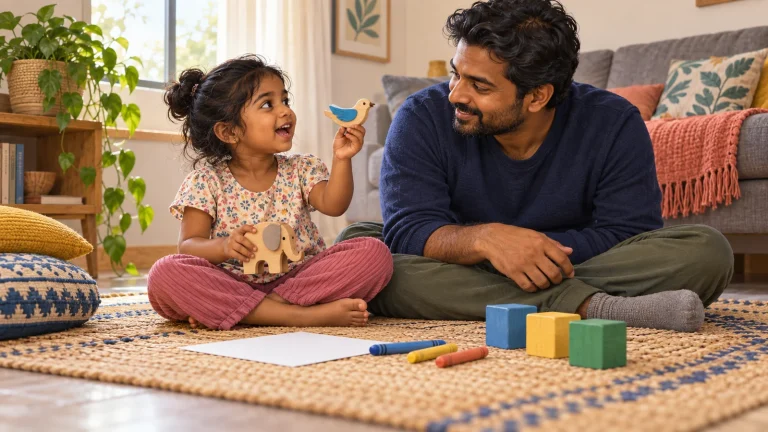
A note for parents and caregivers
You can read the instructions aloud, demonstrate a first step and then let your child try. They do not need to read independently to enjoy these activities. Talk in the language you are most comfortable using together, and give your child time to point, explain or show you an idea.
Choose something that fits their interest and energy today. This is a flexible starting point for shared learning, not a daily timetable or a checklist your child must pass.
Your first small adventure
You need: one familiar toy and a comfortable place to sit together. No printing is needed. Choose a short moment when you can give your child your attention; you can stop after one turn.
- Let your child choose a toy and show you one thing they notice.
- Offer one invitation: describe a colour, count its wheels or tell a tiny story. Choose just one focus.
- Take a turn yourself, then let your child point, speak, move the toy or show an idea.
- Finish by asking what they enjoyed and whether they would like to try it again another day.
Make it easier: offer two choices, such as pointing to a wheel or a window. Accept pointing or a gesture as a response. Try more: invite your child to invent a question for you.
Fitting this around school: choose a familiar activity your child enjoys, rather than repeating a whole school lesson. If you want to reinforce a particular skill, ask their teacher what they are currently practising. This guide offers shared activity ideas; it is not a complete homeschool curriculum.
Build a rhythm you can repeat
1. Choose one small focus
Pick a story, a counting game, a drawing activity or a single sampler activity. Gather only what you need. A clear space and your attention are enough to begin; you do not need a special learning room.
2. Show, try and talk
Show one example if the task is unfamiliar. Then hand the turn back to your child. Ask, “What do you notice?” or “How did you work that out?” Listen to the answer before offering another hint.
3. Finish with a discovery
Ask what they enjoyed or would like to try again. Notice a specific effort: “You checked each object before you counted it.” An unfinished page can still lead to a useful conversation.
Three ways to start today
Tell a picture story
You need: a picture book or a family-friendly illustration.
Look at one picture together. Invite your child to name what they see and imagine what might happen next. Take turns adding one idea to your shared story.
Make it easier: offer a choice: “Is the character going home or going exploring?” Try more: ask your child to explain what in the picture gave them their idea.
Count a tiny collection
You need: three large blocks or toy animals.
Place the objects in a row. Move each object once as you count together. Ask how many there are altogether, then let your child create a collection for you to count.
Make it easier: use two objects and take turns moving them. Try more: rearrange the collection and count again. Find more ideas in our counting-through-play guide.
Draw something you noticed
You need: paper and crayons.
Look at a familiar leaf, toy or household object together. Invite your child to draw one thing they notice. Ask them to tell you about their picture, without correcting it to match your own drawing.
Make it easier: let them point out a colour or shape first. Try more: compare two objects and talk about what is alike or different.
When the activity needs a change
If it feels difficult: reduce the number of steps, show another example or use a real object instead of a picture. You can return to the activity another day.
If it feels easy: invite your child to create a new example, explain their thinking or take the lead while you follow their instructions.
If they lose interest: offer a choice between two activities, add movement or take a break. Finishing a page is not the only useful outcome.
Do we need to print something every day?
No. Conversation, make-believe, drawing and games can all be part of your time together. When you use a printable, choose an activity that connects with what your child is already exploring. Our Learning Approach explains how we use exploration, observation and creativity.
Choose your next small adventure
Start with the free Grade R sampler to try Learnwild together. Read its parent guidance and choose one activity first. Our current learning packs are digital PDFs for printing; a printed book is not included.
Choose another activity from our Grade R letter-sound games or explore beginner Afrikaans words through play. If you are using the sampler, our guide to using a Grade R printable pack explains how to choose and adapt one activity.
Available packs can now be purchased in the Learnwild Shop. You can also download the free sampler.
For a story focus, explore Story Safari. For early number activities, explore Number Trail. Need help with the file? Visit Download & Printing Help.