
Parent Support / Playing with numbers
Grade R counting games to play at home
Turn a few toys, some gentle movement and a little conversation into a number adventure. Start with small groups and play alongside your child, one turn at a time.
Before you begin
These are parent-led game ideas, so your child does not need to read instructions independently. Choose one game and begin with two or three objects. Add another only when your child seems comfortable and interested.
Choose your starting point: use the explorer bag to practise moving one object for each number word, the teddy picnic to give one item to each toy, claps or seated taps for counting movements, or two little collections to compare amounts. Pick one focus for today.
Notice, then repeat: look for your child touching or moving each object once and naming the total at the end. If they miss an object, make a clear row and count together again. Repeat a familiar game with different toys before adding more objects; these observations are a way to choose the next activity, not a pass-or-fail test.
Use large blocks, soft toys, cups or rolled-up socks. Keep small objects away from children who may put them in their mouths, and choose a clear space for movement games.
Count the objects, then name the total
Saying the number words is only part of counting. Help your child touch or move each object once as they say each number. At the end, repeat the total: “One, two, three. Three blocks altogether.” If they count again to check, give them time.
1. Pack an explorer bag
You need: a bag and three large familiar toys.
- Place the toys where you can both see them.
- Ask your child to put two toys into the bag, moving one at a time as you count together.
- Take them out and check the total.
- Swap roles: your child chooses a small number of toys for you to pack.
Ask: “How can we check that we packed two?”
Make it easier: keep the toys in a line and pack one together first. Try more: ask for three, then put one back and explore how many remain.
2. Set a teddy picnic
You need: two or three soft toys and a cup for each.
- Let your child arrange the toys for a pretend picnic.
- Give one cup to each toy.
- Check together: does every toy have one cup?
- Count the toys and then the cups, moving each item once.
Ask: “How did you make sure nobody was left out?”
Make it easier: use two toys with cups directly in front of them. Try more: invite one extra toy and work out what the picnic needs now.
3. Move, clap and count
You need: a clear space; no printing or equipment.
- Invite your child to choose a movement: a clap, a gentle step or a seated knee tap.
- Do two movements together, saying one number for each movement.
- Stop and ask how many movements you made.
- Take turns choosing the movement and a small number to try.
Ask: “Can we make the same number of claps as taps?”
Make it easier: move slowly and join in. Try more: let your child lead a short sequence for you to copy. Use seated movements whenever they are more comfortable.
4. Build two little collections
You need: five large blocks or rolled-up socks.
- Put two objects in one row and three in another.
- Invite your child to count each row.
- Pair one object from each row, side by side.
- Look together for any object without a partner.
Ask: “Which group has more? How could we check?”
Make it easier: start with one object and two objects. Try more: ask your child to make the two groups equal, using an extra object if needed. Let them demonstrate their solution.
What if my child skips an object?
Slow the game down. Move counted objects into a separate space, or put them in a clear row. Demonstrate once, then invite your child to take another turn. Keep your voice curious: “Shall we check together?”
Should we practise writing numbers too?
You can keep these games focused on real objects and conversation. Recognising or writing a numeral is a different task from counting a collection. If you introduce a numeral, connect it to objects your child has just counted rather than adding several new tasks at once.
How do I know when to stop?
Look for your child’s interest and comfort. If they become tired or frustrated, end with a familiar turn and leave the next game for another day. You do not have to complete every game in one sitting.
Further reading for parents: NAEYC explains how counting games support understanding of numbers. These Learnwild games are informal activity ideas, not an assessment.
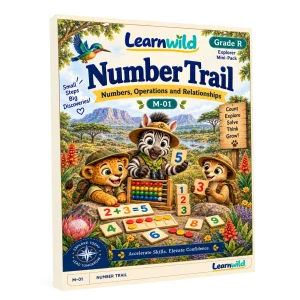
Keep exploring with Number Trail
For ideas that take counting off the page, read how to use a Grade R printable pack at home. When your child is ready for a different kind of game, try our Grade R letter-sound games.
Available packs can now be purchased in the Learnwild Shop. You can also download the free sampler.
If your child enjoys playing with numbers, explore the Number Trail Grade R learning pack. It is a printable digital PDF for you to use together.
Prefer to try Learnwild first? Start with the free sampler. For a gentle home-learning rhythm, read our Grade R learning-at-home guide.